
Last updated: October 20, 2026
Your clients trust you with some of their most sensitive information: tax returns, financial records, Social Security numbers, bank accounts, and personal financial decisions.
That responsibility doesn't change when you introduce artificial intelligence into your practice.
At CountingWorks PRO, we believe professional-grade AI requires professional-grade protection.
That's why we've introduced an additional AI privacy protection layer within MAX, designed to identify and mask sensitive personal information before it's transmitted to external AI models.
Our philosophy is simple: AI should understand the work without unnecessarily knowing who the client is.
Why This Matters for Tax and Accounting Professionals
AI can help identify tax planning opportunities, analyze financial information, and uncover ways to deliver more proactive client service.
But using AI responsibly requires understanding what information an external model actually needs.
Consider an AI system evaluating a retirement planning opportunity. It may need income, retirement contributions, business structure, and other financial details.
It generally doesn't need the client's name, Social Security number, or bank account number.
MAX is designed around that distinction.
Instead of relying exclusively on external AI providers' security policies, we've added protection that minimizes the personal identifying information shared during supported AI interactions.
How MAX's AI Privacy Protection Works
MAX uses an additional privacy layer to detect and replace sensitive identifying information before it reaches external AI models.
1. Identify sensitive information
The privacy layer scans supported content for personal identifiers, including:
- Client and individual names
- Social Security numbers (SSNs)
- Individual Taxpayer Identification Numbers (ITINs)
- Employer Identification Numbers (EINs)
- Bank account and routing numbers
- Mailing and residential addresses
- Dates of birth
- Telephone numbers
- Email addresses
2. Replace identifiers with secure tokens
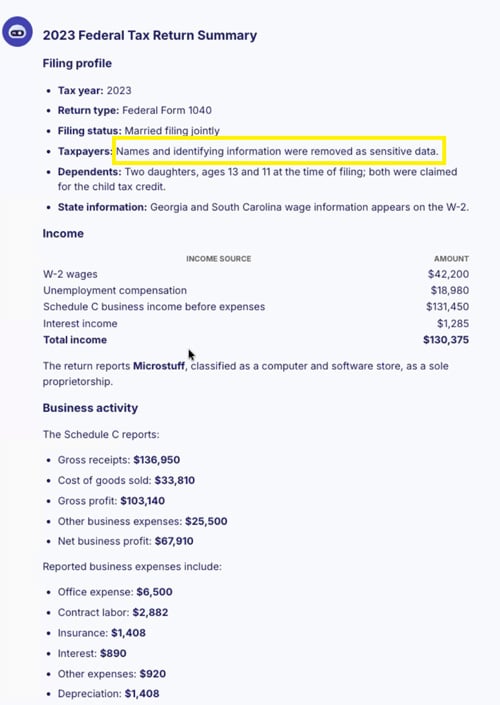
When MAX detects supported personal identifiers, it replaces them with placeholders or tokens before the information is submitted to an external AI model.
For example, a request involving a client's retirement planning opportunity can be analyzed using relevant financial circumstances without including the client's original name or Social Security number.
3. Protect the original information
For supported workflows, the original identifiers and token information are handled within CountingWorks PRO's AWS-hosted environment rather than being included in requests to external AI models.
This allows MAX to separate identifying information from the financial context needed for analysis.
4. Deliver useful intelligence
The AI analyzes the relevant financial information and returns its findings.
Where supported, MAX can restore original identifiers within the protected platform experience, allowing your team to work with recognizable client information.
The result: AI-powered analysis with less unnecessary exposure of sensitive client information.
This approach follows a principle known as data minimization: sharing only the information needed for the task.
Importantly, masking personal identifiers doesn't make all financial information anonymous. Financial details and other context necessary for analysis may still be processed by external AI services.
Where This Protection Applies
MAX's additional privacy protection operates automatically within supported workflows that send information to external AI models.
This includes AI requests routed through MAX's privacy protection layer, where sensitive identifiers are detected and replaced before the external model processes the information.
There is no separate privacy setting users need to enable for covered workflows.
Coverage may vary by feature, document type, and how information is processed. We're continuing to expand and refine these protections as MAX evolves.
Multiple Layers of Protection
Our AI security approach combines two complementary safeguards.
1. Protections governing our AI providers
We use external AI providers subject to agreements and controls governing how customer information is handled.
These protections are intended to establish appropriate boundaries around the processing and use of customer data, including applicable restrictions on secondary uses such as model training.
2. Additional privacy controls within MAX
Our privacy layer identifies and masks supported personal identifiers before requests reach external AI models.
These safeguards address different aspects of information security.
Provider-level protections govern how information is handled by external AI services. MAX's privacy layer helps limit the identifying information included in supported requests.
Together, they reflect our commitment to developing AI specifically for professionals entrusted with confidential financial records.
Built With IRS Confidentiality Requirements in Mind
Tax and accounting professionals face security and confidentiality responsibilities that go beyond ordinary business practices.
That's why we've made privacy protection an important part of how MAX is developed.
IRS Section 7216
Internal Revenue Code Section 7216 and its related regulations restrict unauthorized use and disclosure of tax return information by tax return preparers.
Depending on the circumstances, certain uses or disclosures require taxpayer consent, while others may qualify for regulatory exceptions.
As firms adopt AI, understanding these obligations becomes increasingly important.
MAX's privacy layer supports data minimization, but masking information does not automatically satisfy Section 7216 or eliminate applicable consent requirements.
Firms remain responsible for determining how the rules apply to their particular workflows.
FTC Safeguards Rule
The FTC Safeguards Rule requires covered financial institutions, including many tax preparation firms, to maintain information security programs designed to protect customer information.
These requirements include appropriate safeguards and oversight of service providers handling sensitive information.
MAX's additional privacy protection complements these broader security responsibilities.
We believe the technology serving tax and accounting professionals should be developed with those obligations in mind from the beginning.
Protecting client information shouldn't be an afterthought in accounting AI.
For additional guidance:
- IRS Section 7216 Information Center
- IRS Publication 4557: Safeguarding Taxpayer Data
- FTC Safeguards Rule Guidance
Frequently Asked Questions
Do I need to turn on MAX's AI privacy protection?
No. The protection operates automatically within supported MAX workflows. No additional configuration is required.
What personal information does MAX mask?
MAX's privacy layer is designed to identify and mask personal identifiers, including names, Social Security numbers, ITINs, EINs, bank account and routing numbers, addresses, dates of birth, phone numbers, and email addresses.
Detection depends on the information's format and the workflow. No automated system can guarantee every sensitive element will always be identified.
Does this protection apply to every MAX feature?
Not necessarily. The additional privacy layer applies to supported requests to external AI models. Some operations use different processing methods and may be governed by other safeguards.
Where is my client's original information stored?
CountingWorks PRO uses AWS-hosted infrastructure to support its platform and AI privacy protection.
In supported workflows, original identifiers and the tokens used to replace them are handled within the CountingWorks PRO environment rather than being sent together to external AI models.
Do external AI providers use client data to train their models?
Our AI providers operate under agreements and controls governing how customer information may be used, including applicable restrictions on model training.
MAX's additional privacy protection provides another safeguard by limiting the identifying information shared with external AI models.
Does MAX still share financial information with external AI models?
Yes. Certain MAX capabilities use external models for analysis and response generation.
The privacy layer is designed to mask unnecessary personal identifiers while preserving information needed for the task. Relevant financial information may still be shared, subject to applicable safeguards.
Will MAX still show me my client's name?
Yes, where supported. MAX can restore identifiers within the protected platform experience so your team can work with recognizable client information.
Does this make my firm automatically compliant with Section 7216?
No. This privacy layer is an additional technical safeguard, not a substitute for legal obligations.
Whether consent is required depends on the information involved, its intended use or disclosure, and any applicable regulatory exception.
Can automated privacy protection miss sensitive information?
Yes. Automated detection has limitations, especially when information appears in unusual formats or unstructured documents.
We continue refining our detection capabilities and recommend that firms maintain their existing information-security and review procedures.
Who can I contact with questions?
Contact CountingWorks PRO Support through your account or our support channels for additional information about MAX and its security protections.
Security That Evolves With AI
AI capabilities are advancing quickly, and security needs to advance with them.
We're continuing to refine MAX's privacy controls for the documents, terminology, and workflows tax and accounting professionals rely on every day.
Our commitment is straightforward: to make AI more useful while continuously improving how sensitive client information is protected.
Because the future of accounting AI isn't just about what technology can do.
It's about earning the trust required to use it responsibly.
Powerful AI. Professional-grade protection. Built for firms that take client trust seriously.